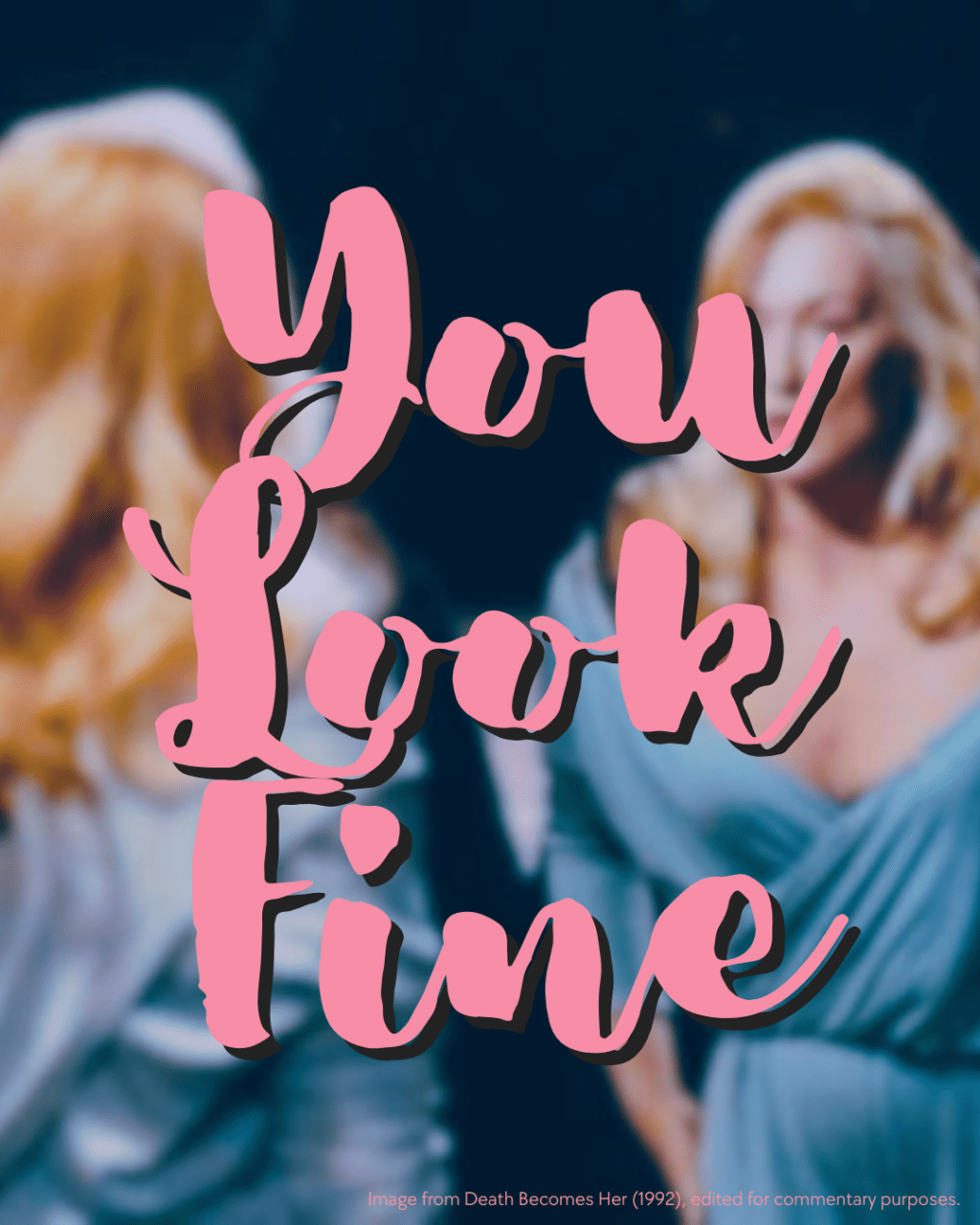
As far as I can tell, blue is the color we give to sorrow we don’t want to name—grace under pressure, beauty misunderstood, pain made elegant. And no one wears it like Madeline Ashton.
It’s easy to make her the villain. She’s glamorous. Dramatic. Unapologetically loud. She walks like she owns the room—because for most of her life, she had to act like she did just to be allowed in it.
In Death Becomes Her, Madeline is cast as the narcissist. The movie star. The woman who takes what isn’t hers. But what if the story isn’t as simple as it seems?
Let’s talk about Helen. She wears red and black—deep, commanding colors typically used in film to signal danger, vengeance, or passion. She’s the one who spends years obsessing over Madeline, plotting her death, and quite literally weaponizing her pain. And yet, she’s seen as the sympathetic one.
But it’s worth looking closer. Helen isn’t cruel for sport. She’s furious because she was taught that beauty was currency, and losing it meant losing everything. Her anger is real—it’s the anger of someone who played by the rules and still ended up discarded. If society taught Madeline to perform softness, it taught Helen to perform rage: sharpened, bitter, barely disguised as comedy.
Both women are reacting to the same wound. The same impossible expectations. They just wear their injuries differently.
Madeline, on the other hand, wears pastels. Soft blues, petal pinks, ivory whites. She’s styled like a heroine, but spoken about like a villain. Not because of what she does—but because of who she dares to be.
She stands up for herself. She doesn’t collapse into apology. Even when she’s falling apart—bone-deep and broken—she still carries herself with grace. With humor. With edge. And people hate her for it.
Much of the film’s emotional sleight of hand happens in the wardrobe. Madeline wears softness like armor—powder blue suits, blush silks, lavender gowns that drape like forgiveness. She looks like the ingénue, the wounded romantic, the woman who’s supposed to be saved. But the softness is a costume. It shields a woman who’s already learned that power must be pretty if it wants to be tolerated.
Helen, by contrast, is cloaked in reds, blacks, and jewel tones—colors that scream vengeance, seduction, control. Even before the plot to kill Madeline takes shape, Helen is dressed like a femme fatale. It’s not subtle. But because she presents her rage in clever quips and wounded sighs, the audience forgives her. Her anger is framed as righteous. Her violence becomes comedic.
That’s the trick. The movie knows how to manipulate our empathy by using fashion as shorthand for morality. Madeline looks like the heroine, but we resent her. Helen dresses like the villain, but we root for her. Costume becomes commentary, a deliberate inversion of visual cues. It’s part of what made the film iconic enough to inspire a musical—the looks are as unforgettable as the lines, and just as layered.
And then there’s the potion. Eternal youth, sold in a vial like salvation. But it doesn’t save them—it traps them. Suspends them in the most performative version of themselves. Their bodies gleam, their skin smooths, but the ache doesn’t fade. Because the real cost of being frozen in beauty is that no one expects you to grow. Only to sparkle. Only to stay still.
That’s not immortality—it’s imprisonment with good lighting.
The real turning point isn’t the potion, though. It’s a fight with shovels—a cartoonish battle that accidentally unearths something real.
Mid-brawl, the past finally erupts:
Helen: “You stole my boyfriends just to hurt me!”
Madeline: “You thought I was cheap!”
Helen (after a pause): “Okay. I thought you were cheap.”
Madeline (after another, longer pause): “Well, I hurt you on purpose.”
It’s messy. It’s raw. It’s not clean forgiveness—but it’s honest.
Two women, trapped by the images they were forced to perform, finally confess the quiet violence they inflicted and endured.
Madeline’s apology comes not from weakness, but from the ache of being misunderstood for a lifetime. Helen’s apology is harder won—and even then, it is incomplete, tinged with the bitterness of someone who still can’t quite believe what the world demanded of her.
Death Becomes Her plays with an old trope—the diva downfall, the vain woman undone by her vanity. But Madeline refuses to play it the way she’s supposed to. She never begs to be loved, only to be seen. And when the world mocks her for wanting more, she doesn’t soften—she sharpens.
That’s the part no one forgives. Not the glamour. Not the drama.
The refusal to apologize for taking up space.
We villainize women like Madeline because they don’t perform their pain in ways we find palatable. We call them selfish for not shrinking. We call them dramatic for not being ashamed of their power.
We love a woman in blue only when she’s quiet about what it costs to wear it.
But blue is the color of bruises and jazz. It’s the unsung note in a Miles Davis solo. It’s melancholy wrapped in elegance. It’s dignity that refuses to decay quietly.
And Madeline is blue—aching, radiant, complicated. We weren’t ready to see her.
Because as far as I can tell, Death Becomes Her isn’t a story about bad women.
It’s a story about what happens when women are told their only choices are to vanish—or to destroy each other.
And Madeline Ashton deserved to be read as what she really was:
a woman who refused to dim her light just because someone else preferred the shadows.
And maybe that’s the most beautiful thing she ever did.
 JENTHEORY
Leave a comment